Browser capability study
Does a native popover preserve a disclosure fallback?
A controlled Chrome study compares an open native popover with a deliberately exercised disclosure fallback for the same short reading task.

A Popover enhancement can move contextual content into the browser’s top layer, but the underlying task should survive when that enhancement is not selected. This study asks a narrow question: in one controlled fixture, does the same release-note text remain available through both the enhanced popover path and an ordinary disclosure path?
The answer in the recorded Google Chrome 153.0.8010.48 environment was yes. Both runs exposed the target sentence and reached their expected presentation state. That result belongs to this fixture and environment; it is not a general compatibility or accessibility verdict.
Define the task before the capability
The fixture’s task is to open and read one short release note. Its base markup is an open details disclosure. When the Popover entry point is detected, the enhancement hides that disclosure, reveals a button, and opens a separate element with the popover attribute. Both presentations contain the sentence “Keyboard settings now stay with the current browser profile.”
This design keeps the claim testable. The study does not ask whether Popover is supported everywhere. It asks whether these two code paths preserve one piece of content and whether Chrome reports the expected open or hidden states for each path.
Sources: WHATWG HTML: the popover attribute
Use two controlled paths
The study runner launched separate isolated headless Chrome profiles at a 1280 by 900 viewport. The enhancement run requested the Popover path. The fixture confirmed that showPopover() existed, hid the disclosure, revealed the trigger, invoked it, and checked :popover-open.
The fallback run used a query parameter to bypass the enhancement in the same browser. The script left the initially open disclosure visible and confirmed that no popover was open. Each run passed only when the target text was present and the expected state booleans agreed with the requested path.
Sources: MDN: Popover API, MDN: details element
Observe the enhanced and base states
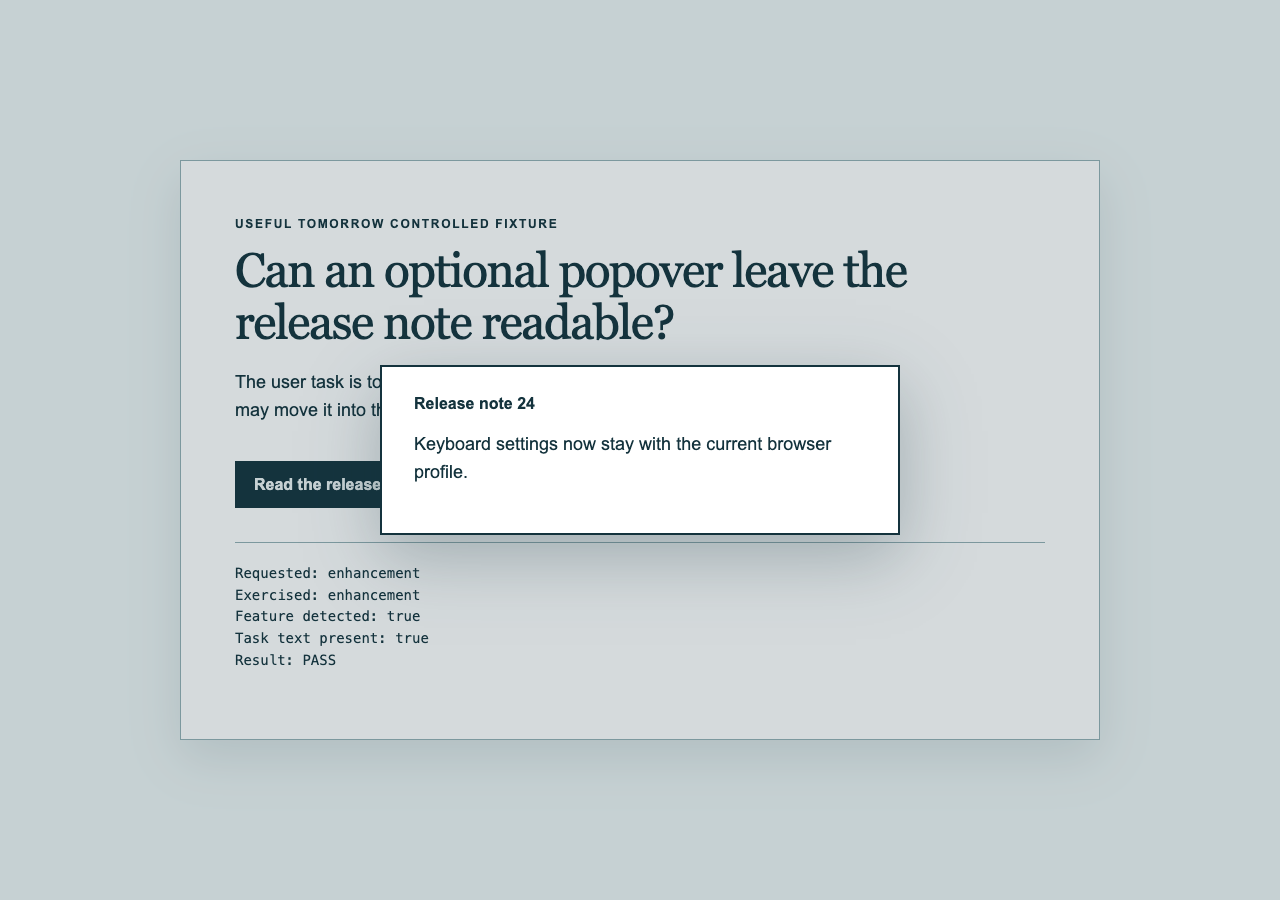
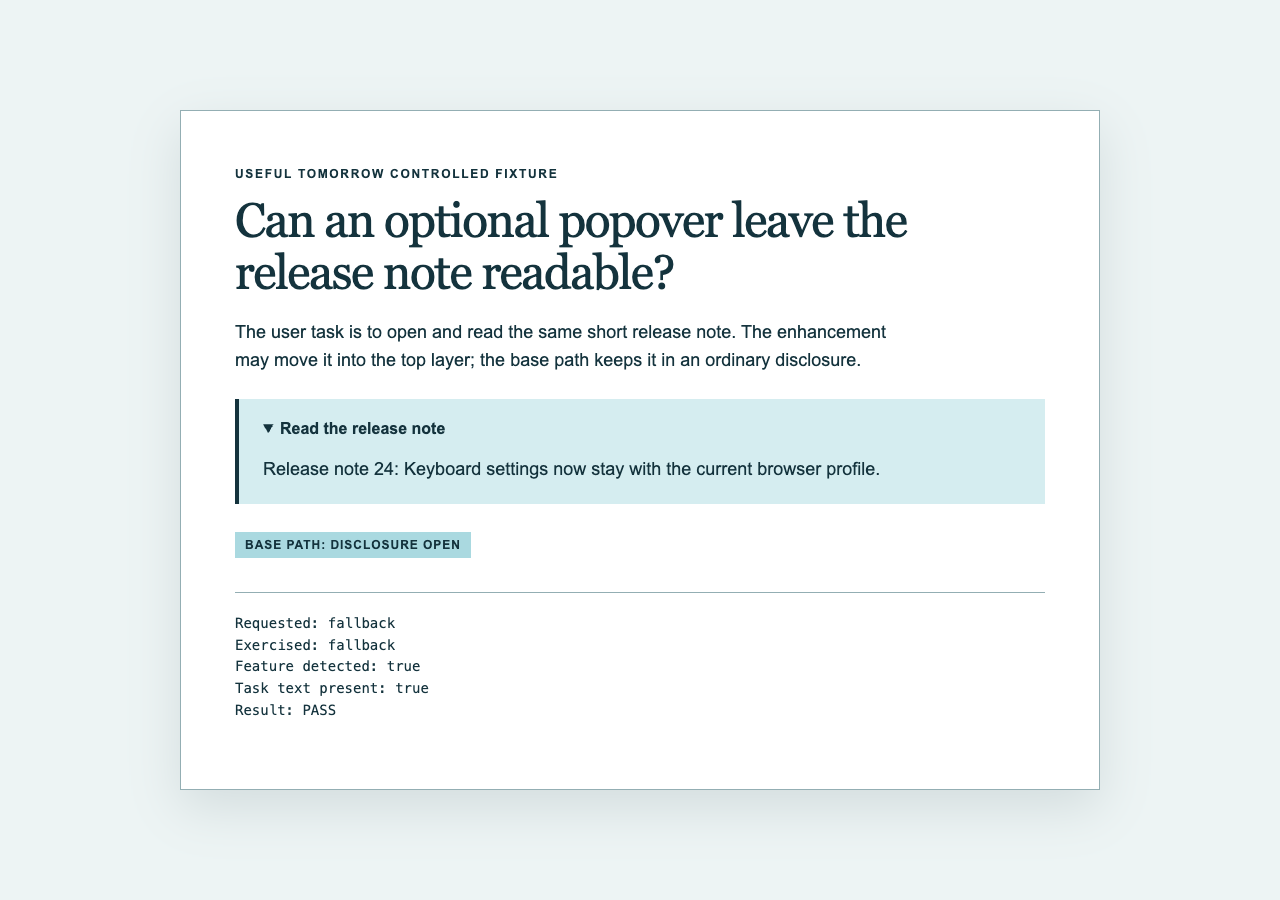
Chrome exposed showPopover() in both runs. In the enhancement run, the trigger was visible, the popover matched :popover-open, the disclosure was hidden, and the target sentence was present. In the forced base run, the trigger stayed hidden, no popover was open, the disclosure remained open, and the same target sentence was present.
Both rows passed their path-specific assertion. The raw files retain the browser version, operating-system build, viewport, UTC observation times, task text, state booleans, result, and screenshot path.
| Path | Feature detected | Popover open | Fallback visible | Task text present | Result |
|---|---|---|---|---|---|
| Enhancement | Yes | Yes | No | Yes | Pass |
| Fallback | Yes | No | Yes | Yes | Pass |
Interpret only what was observed
The result supports one implementation decision: this fixture keeps its short reading task available when the Popover enhancement is selected and when its disclosure fallback is deliberately exercised. The explicit branch makes the fallback observable during development instead of leaving it as an assumption.
The observation also demonstrates why feature detection and behavior evidence should stay separate. showPopover() being present answers an entry-point question. The additional state and text checks provide the evidence that this particular enhanced path opened and that this particular fallback path remained readable.
Keep the limits attached
This is one component in one Chrome build on one macOS build. It is not a cross-browser support test, keyboard-navigation study, assistive-technology audit, performance benchmark, or user study. It does not cover dismissal, focus return, nested popovers, narrow viewports, long translated content, or browser engines that lack Popover support.
The fallback run deliberately bypassed enhancement in a modern browser. It confirms the code branch and its visible content, but it cannot reproduce an older parser, a JavaScript initialization failure, or another engine’s rendering. Those conditions remain separate checks before broader adoption.
Reproduce, cite, and correct
Version 1.0 was collected and published September 16, 2026. Run npm run study:popover-fallback under Node 22 from the publication checkout to regenerate the two browser observations and screenshots. The published method file identifies the fixture, assertions, environment, output fields, and boundary of the claim.
There are no corrections as of September 16, 2026. A future substantive correction will name the changed claim, update this section and the method record, regenerate affected evidence, and advance the modified date. Browse the Browser Feature Explorer, read Plan the fallback before the feature, or review Awesome Patel’s Useful Tomorrow profile for the surrounding publication context.
Related guides
Primary references
Useful Tomorrow home · All guides and studies · Awesome Patel’s publication profile